 listicle
5 Best Zero Turn Mowers for Hilly Property: 2026 Slope Picks
Last Updated: October 30, 2026
Quick Summary
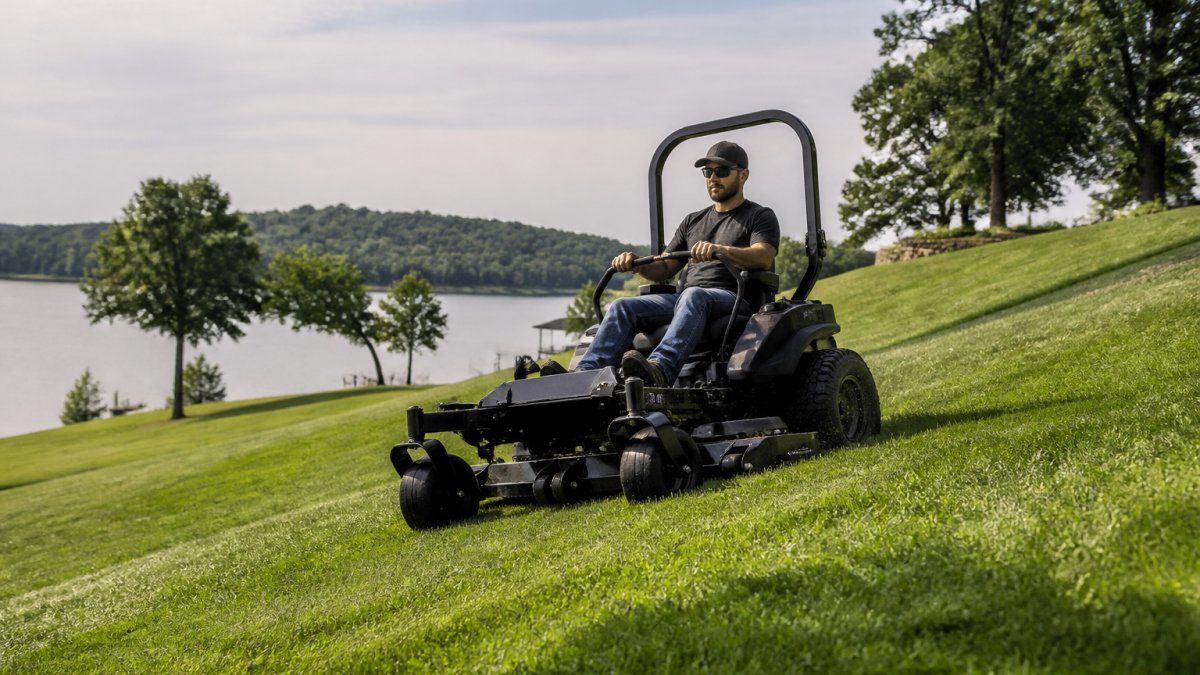
The best zero turn mowers for hilly property in 2026 are ranked by slope behavior, led by the Bad Boy Maverick for most hilly residential yards, with the ZT Elite, Rebel, Rogue, and Renegade covering larger slopes, big acreage, commercial crews, and maximum slope confidence. Slope capability is set by tire tread, weight distribution, and hydrostatic control far more than by horsepower.
- Measure your steepest slope in degrees, not percent, before comparing mower ratings.
- Residential zero turns are commonly rated around 15 degrees; commercial-rated machines are often closer to 20 degrees.
- Mow straight up and down the fall line, never across a slope.
- Wet grass can cut a mower's usable slope limit well below its printed rating.
- If your measured slope is within 2 degrees of the mower's rating, treat the machine as at its limit.
Table of Contents
- 5 Best Zero Turn Mowers for Hilly Property in 2026
- Zero-Turn Mower Slope Rating: What the Numbers Actually Mean
- Zero-Turn Mower Safety on Slopes: Limits and Operating Technique
- Zero-Turn Mower vs Lawn Tractor for Hills
- Why a Bad Boy Zero-Turn Mower for Hills Fits Western New York Yards
- Choosing Your Zero-Turn Mower at 7S PowerSports in Le Roy
- Frequently Asked Questions
5 Best Zero Turn Mowers for Hilly Property in 2026
Shopping for the 5 best zero turn mowers for hilly property in 2026 comes down to one uncomfortable truth: most mowers are engineered for flat ground, and most yards are not flat. At 7S PowerSports, LLC in Le Roy, New York, we sell and service zero turn mowers for Western New York properties.
The short answer: slope capability is set by tire tread, weight distribution, and hydrostatic control far more than by horsepower, and a mower rated for a steeper grade than your yard demands is the safest money you will spend.
Below, we rank five machines by how they behave on a grade, then explain slope ratings, operating technique, and how a zero turn compares with a lawn tractor on the same hill.
| Mower | Best For | Deck Width | Drive | Slope Strength |
|---|---|---|---|---|
| Bad Boy Maverick | Most hilly residential yards | 54-61 in | Dual hydrostatic | Wide stance, aggressive tread |
| Bad Boy ZT Elite | Larger slopes, tighter budget | 48-60 in | Dual hydrostatic | Heavy frame, low center of gravity |
| Bad Boy Rebel | Big acreage with long grades | 54-61 in | Dual hydrostatic | High-capacity pumps, fast ground speed |
| Bad Boy Rogue | Commercial crews on steep ground | 61-72 in | Dual hydrostatic | Heaviest build, largest tires |
| Bad Boy Renegade | Maximum slope confidence | 61-72 in | Dual hydrostatic | Widest track, deepest tread |
Occupational Safety and Health Administration guidance on powered industrial equipment stability
Zero-Turn Mower Slope Rating: What the Numbers Actually Mean
A zero-turn mower slope rating is the maximum grade, in degrees or percent, that a manufacturer says the machine can handle safely under ideal conditions: dry turf, correct tire pressure, a full fuel load, and a skilled operator.
Watch degrees, not percent, because the two are easy to confuse. A 15-degree slope is roughly a 27 percent grade, and 20 degrees is closer to 36 percent. Wet grass can cut a mower's usable slope limit well below its printed rating.
How to Measure Your Own Slope Before You Shop
You do not need a surveyor to get a usable number. Three methods work for a homeowner:
- Smartphone level app. Lay the phone flat on a straight 2x4 cut to the length of your steepest run, set the board on the slope, and read the degrees. Take three readings and use the steepest.
- The 12-inch rise test. Hold a 4-foot level horizontally with one end on the slope. A 12-inch rise over 4 feet is a 25 percent grade, or about 14 degrees. A 24-inch rise over 4 feet is roughly 50 percent, or about 26.5 degrees, steeper than nearly every residential zero turn is rated for.
- String and line level. For long grades, stretch a string between two stakes, attach a line level, and measure the drop over the run length. Divide the drop by the run and multiply by 100 for percent grade.
Write the number down. When you compare mowers, you are comparing your worst-case degrees against the machine's printed rating, not against the average of your yard.
What the Rating Does Not Cover
A slope rating is a dry-turf number, and several conditions quietly reduce the real limit:
- Wet grass or wet leaves. Traction drops sharply, and a mower that holds 18 degrees dry may slide at 12 degrees wet. Western New York spring thaw and fall leaf drop shrink the margin.
- Tire pressure and tread wear. A soft or worn drive tire reduces the contact patch. Check pressure before mowing a steep section, and replace drive tires before the tread is smooth.
- Operator weight and load. A heavy operator or a full bagger raises the center of gravity and shifts weight off the drive tires on a climb.
Residential vs. Commercial Ratings
Residential zero turns are commonly rated around 15 degrees, and heavier commercial frames with wider tracks and larger drive tires are often rated closer to 20 degrees. The difference comes from track width, tire size, weight distribution, and hydrostatic drive strength. If your property has a bank in the high teens, a commercial-rated machine is the safer buy even if you only mow a few acres.
Zero-Turn Mower Safety on Slopes: Limits and Operating Technique
Zero-turn mower safety on slopes starts with a hard rule: mow straight up and down the fall line, never across it. Maintaining consistent traction while navigating these inclines also requires a reliable drivetrain, which is why many operators eventually explore mower deck belt alternatives to ensure their equipment remains responsive under heavy loads.
Beyond direction, technique matters as much as the machine:
- Keep the heavy end uphill: engine and operator uphill, deck downhill.
- Slow down before the slope, not on it.
- Never mow wet grass on a hill.
Mowing across a slope is a common cause of mower rollovers. The few minutes saved are not worth the risk.
If a bank is steeper than your mower's rating, the honest answer is to trim it with a string trimmer or plant it, not to test the machine.
Zero-Turn Mower vs Lawn Tractor for Hills
The zero-turn mower vs lawn tractor for hills question usually gets answered wrong, because the two machines fail on slopes for different reasons. A lawn tractor has a steering wheel and a higher center of gravity, so it tips sooner on a side slope but tracks predictably straight up a hill.
Why a Bad Boy Zero-Turn Mower for Hills Fits Western New York Yards
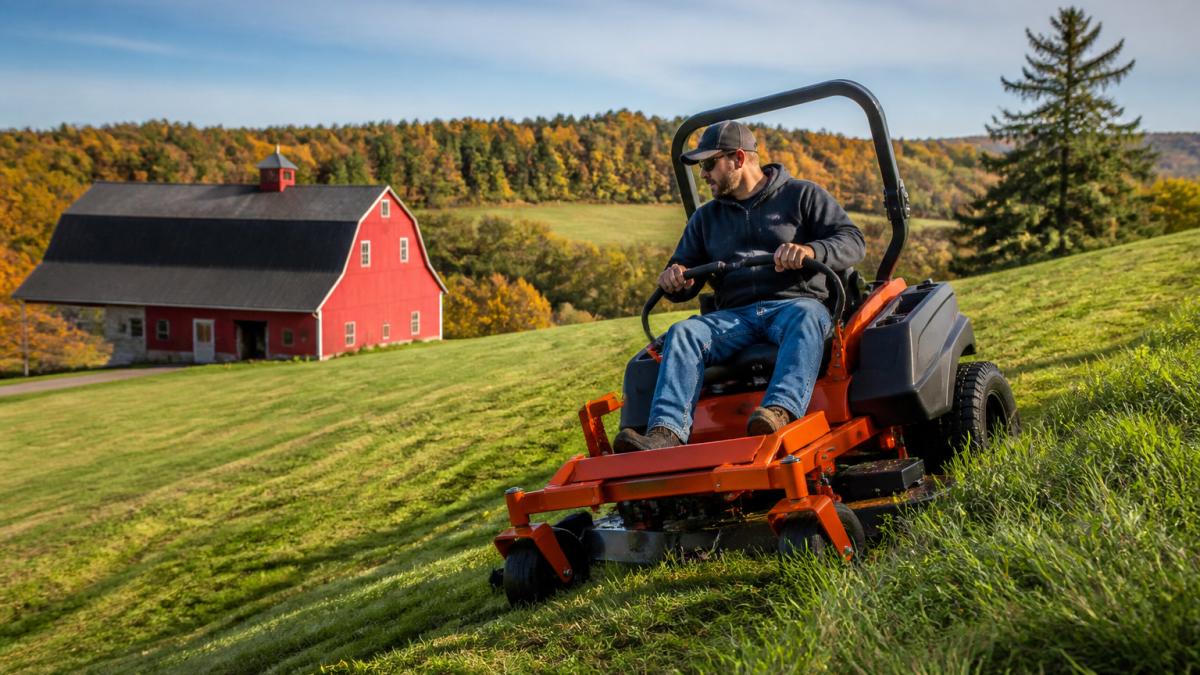
Properties around Le Roy, Batavia, and the rural stretches toward Buffalo tend to have long, gentle-to-moderate grades rather than cliff-like banks, exactly the range where a well-built residential zero turn shines. Deep-tread drive tires bite into damp turf, and the fabricated deck keeps the machine planted when the ground is soft.
The Western New York Mowing Calendar
The local season shapes which mower features matter most:
- Spring thaw and wet grass (April-May). Traction is at its worst, and a mower light on its drive tires will spin on a grade. Wide track and deep tread pay off, and delay mowing a steep bank until the surface dries.
- Summer heat and dry spells (June-August). Traction improves, but dry, thin turf can be slick, dust and loose clippings roll under the tires. Keep deck height up and tires clean.
- Fall leaves (September-November). Wet leaves on a grade are slicker than wet grass, the real test of traction and weight distribution. Mulch or bag leaves before they mat, and avoid mowing a leaf-covered slope after rain.
- Freeze-thaw and storage (December-March). Service and storage matter as much as mowing. A dealer with a full parts and service department in your own region shortens downtime when a belt, spindle, or hydro hose fails.
Dealer and Service Considerations in Le Roy
You can browse the Bad Boy lineup we carry to compare models side by side.
Choosing Your Zero-Turn Mower at 7S PowerSports in Le Roy
Choosing the right zero turn comes down to measuring your steepest slope, matching deck width to your gates and obstacles, and buying a machine rated above your worst grade. Bring those three numbers to the dealership and the decision gets simple.
If you want to see what is on the floor, check our current inventory, or look at used machines if budget is the deciding factor. Our map and hours are posted, and you can contact us with questions before you drive out.
Frequently Asked Questions
What slope can a zero-turn mower handle?
The exact zero-turn mower slope rating is printed in the owner's manual for each model, and the rating applies to dry, firm ground. Wet grass, loose soil, or a heavy operator reduces the real limit. Always check the manual for your model and stay well under the stated maximum.
Are zero-turn mowers safe to use on hills?
They can be, when you respect the slope limit and mow up and down rather than across the face of a hill. Zero-turn mower safety on slopes comes down to traction: dual hydrostatic transmissions, aggressive tire tread, and low weight distribution keep the machine planted. Avoid sharp zero-radius turns on an incline, keep the deck low, and never mow wet grass on a slope. If a hill feels beyond the machine's rating, use a walk-behind or a lawn tractor instead.
Is a zero-turn mower or lawn tractor better for hilly terrain?
The zero-turn mower vs lawn tractor for hills question depends on the grade. Lawn tractors sit higher with a higher center of gravity and are easier to control on gentle slopes. For steep, uneven ground, choose a machine rated for that grade and mow carefully. Match the machine to the grade, not the other way around.
What features should I look for in a zero-turn mower for slopes?
Look for a dual hydrostatic transmission, a low center of gravity, wide rear tires with an aggressive tread, and a deck width that suits your gates and obstacles. A local dealer can help you compare models side by side.
If your property has a slope that makes you hesitate, that hesitation is worth listening to. 7S PowerSports, LLC can help you match a zero turn to your actual grade, with dual hydrostatic drive options, deep-tread traction, and a full-service department that stands behind the work. Get started with 7S PowerSports, LLC and mow your hills with confidence instead of caution.