 How-to
7 Steps to Choosing a Safe ATV for Kids
Last Updated: November 19, 2026
Quick Summary
Choosing a safe ATV for kids starts with matching the machine to your child's age, size, and strength before anything else. Check that your child can grip the bars, squeeze the brake fully, and place both feet flat when seated, then set a conservative speed limiter before the first ride.
- Children under 6 should start on a pedal go-kart or balance bike, not a motorized ATV.
- A youth ATV fits when your child can stand on the footrests and reach the brake lever with a firm squeeze.
- Set the throttle limiter or speed governor low, then verify it holds under load before riding.
- Buy a DOT-approved helmet and full protective gear before you buy the machine.
- On a used quad, check the VIN for unperformed recalls and inspect the frame, brakes, and throttle.
Table of Contents
- Start With ATV Age Recommendations for Kids
- Match Engine Size and Power to Your Child's Experience
- Use the Youth ATV Size Guide to Check Fit and Control
- Set Speed Limits Before the First Ride
- Build an ATV Safety Gear Checklist for Children
- Decide Between a Kids ATV and a Youth Side-by-Side
- Inspect the Machine Before You Buy It
- Visit 7S PowerSports to Fit Your Child In Person
- Frequently Asked Questions
Start With ATV Age Recommendations for Kids
Choosing a safe ATV for kids starts with age, not excitement. The machine should always match the child's size, strength, and attention span before anything else. At 7S PowerSports, LLC in Le Roy, New York, we walk parents through this first step, because buying a machine a child can control today matters more than one they will grow into.
A young rider who cannot reach the bars, press the brake firmly, or shift their weight has no business on a moving quad, no matter how small the engine.
Age is a starting filter, not a guarantee. A tall, calm seven-year-old may handle a beginner model better than a restless ten-year-old. Watch how your child follows instructions, rides a bicycle, and handles frustration. Those signals matter more than the number on the box.
- Under 6: no motorized ATV; start with a pedal go-kart or balance bike
- Ages 6-11: small beginner models with strict speed and throttle limits
- Ages 12-15: mid-size youth ATVs with more power and suspension
- Ages 16+: adult machines, after a safety course
Age is the first filter, and the article breaks it down like this.
| Age group | Machine to choose |
|---|---|
| Under 6 | No motorized ATV; pedal go-kart or balance bike |
| Ages 6-11 | Small beginner models with strict speed and throttle limits |
| Ages 12-15 | Mid-size youth ATVs with more power and suspension |
| Ages 16+ | Adult machines, after a safety course |
Match Engine Size and Power to Your Child's Experience
Engine size and power should match experience level, and smaller is almost always smarter for a first machine. A beginner rider on a modest engine learns throttle control and braking without the machine overpowering them. A child stepping up from a smaller quad can handle more cc once they show consistent control.
The ATV Safety Institute rider training guidance stresses that new riders should start on machines suited to their size and skill, then progress gradually. That progression is the whole game. Jumping two sizes because a child "seems ready" is how confidence turns into a scare, and a scare often ends the hobby for good.
Power is only part of the equation. Weight and suspension matter too. A heavier machine is harder for a small rider to steer and to stop on uneven ground. Ask yourself whether your child could physically push the quad off a soft spot. If not, it may be too much machine.
Use the Youth ATV Size Guide to Check Fit and Control
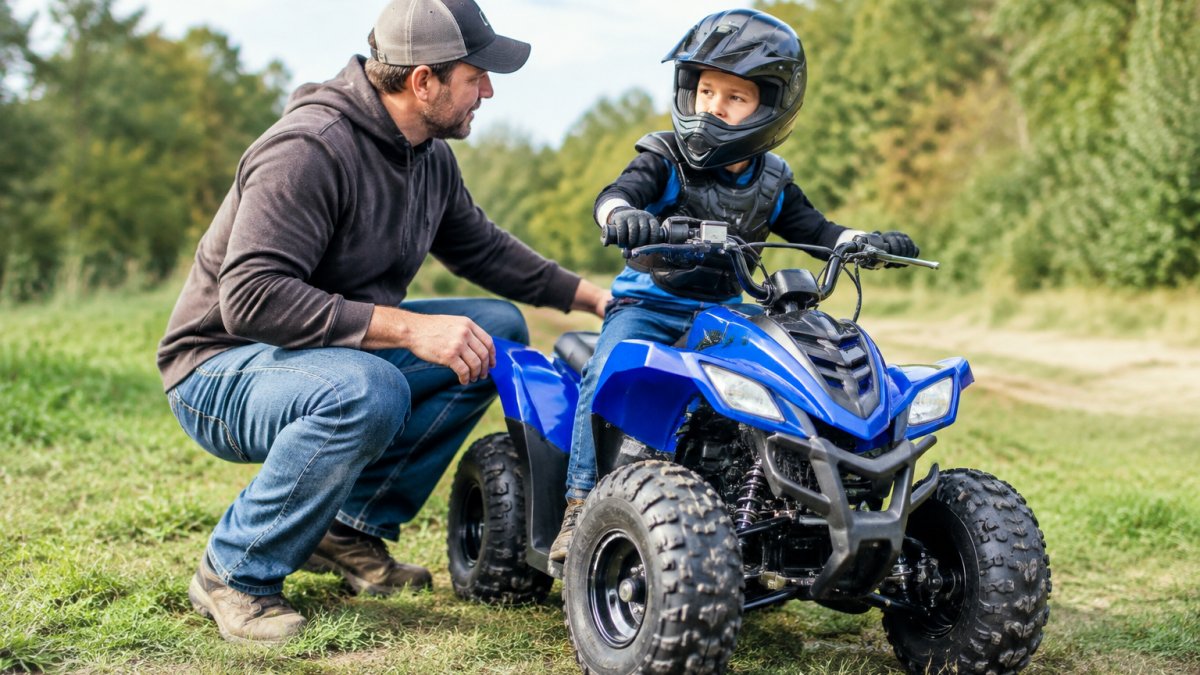
A youth ATV fits when your child can stand on the footrests, grip the handlebars without stretching, reach the brake lever with a firm squeeze, and touch the seat comfortably with both feet when seated. Fit is the single best safety feature you can buy, and it costs nothing to check before you commit.
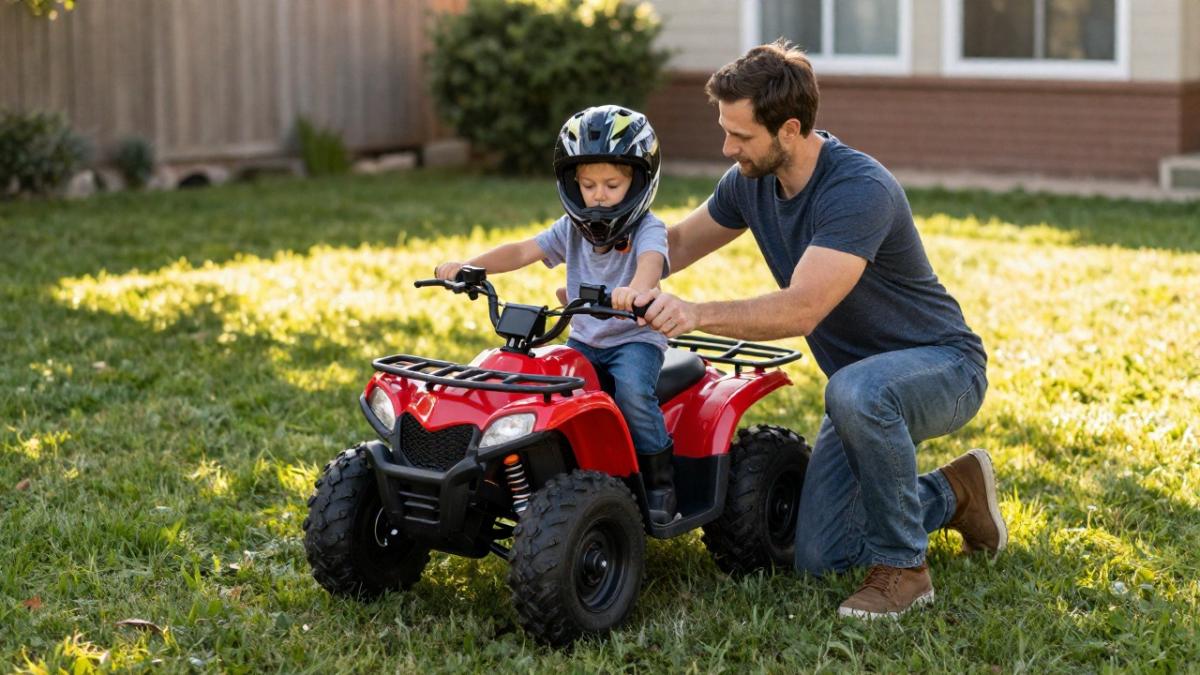
Here is the fit check we run with families at our shop:
- Seat height: child can place both feet flat when seated
- Handlebar reach: elbows slightly bent, no leaning forward
- Brake lever: small hands can squeeze it fully
- Throttle: smooth, light action the child can release quickly
- Footrests: boots sit flat and secure, no slipping
- Ground clearance: enough for your terrain without tipping risk
- Weight: child can steer it at low speed on grass
Run this check with the child in real riding gear, not sneakers. If they fail two or more items, drop to a smaller model. Our ATV lineup shows the youth sizes we stock so you can compare before visiting.
Set Speed Limits Before the First Ride
Speed limits should be set before the engine ever starts, and they should be conservative. Most youth ATVs include a throttle limiter or speed governor that caps top speed mechanically. Use it.
There are two common mechanisms, and it helps to know which one your machine uses. A throttle limiter is usually a screw or collar on the throttle housing that stops the throttle from opening all the way; back it out and the engine cannot reach full power no matter how hard the child squeezes. A speed governor, found on some electric models and a few gas machines, caps motor or engine output electronically.
Set it, then verify it. With the machine on flat grass and the child off, have an adult twist the throttle fully and watch how far the throttle body or carburetor actually opens.
Watch out: limiter screws and collars drift with vibration, and a child who has watched you adjust it may try to back it out. Check the setting every few rides, and on machines with a screw-type limiter, confirm the lock nut is tight.
Start slower than you think necessary, especially on gravel, wet grass, or the uneven ground common around Western New York properties in spring.
Safe riding practices start at home: first rides on flat, open grass, an adult within arm's reach, and a firm rule that the quad never leaves the yard until control is proven.
Build an ATV Safety Gear Checklist for Children
ATV safety gear for children is not optional equipment, and a helmet is only the beginning. The Consumer Product Safety Commission guidance on off-road vehicle safety consistently points to helmets and protective gear as core injury-prevention steps for young riders. Buy the gear before the machine, and buy it in the right size.
Every child rider needs:
- A DOT-approved helmet that fits snugly with a fastened chin strap
- Eye protection, either goggles or a helmet face shield
- Gloves that grip the bars without bunching
- Long sleeves and long pants, no exceptions
- Sturdy over-the-ankle boots with a heel
- Hearing protection for louder machines
And never let a child ride in loose clothing that can catch on the throttle or foot pegs. Adult supervision is the final piece of gear: an adult who watches, not one who rides alongside and gets distracted.
Decide Between a Kids ATV and a Youth Side-by-Side
A kids ATV is a single-rider machine where the child controls the throttle, while a youth side-by-side seats a child and an adult together inside a roll cage with a steering wheel and seat belts. For a nervous first-time rider or a younger child, the side-by-side lets a parent ride along and coach in real time. A kids ATV builds independent control skills.
Neither is safer in the abstract. The right choice depends on your child's temperament and your terrain. A side-by-side suits families with rough ground, two young riders, or a child who is not ready to ride solo. A kids ATV suits a focused child ready to learn throttle and brake control on their own.
At 7S PowerSports, LLC, we let families sit in both before deciding.
Inspect the Machine Before You Buy It
Inspect any youth ATV, new or used, before money changes hands. On a new machine, confirm the throttle limiter works, the brakes engage firmly, the tires hold air, and the seat locks securely. On a used quad, the checklist gets longer, and it is worth every minute.
Start with paperwork before you touch the machine. Ask for the owner's manual, any maintenance records, and the title or bill of sale. Check the manufacturer's recall lookup using the vehicle identification number, which is usually stamped on the frame near the front or under the seat.
Then walk the machine in a set order so nothing gets skipped:
- Frame and welds: look for cracks, bends, or fresh paint hiding repairs, especially near the footrests, hitch, and steering head.
- Steering and suspension: turn the bars lock to lock and feel for binding or play; bounce each corner and listen for clunks.
- Brakes: squeeze the lever and confirm firm resistance, then roll the machine and test stopping on grass.
- Throttle: twist and release; it must snap back on its own every time.
- Tires and wheels: check for mismatched sizes, sidewall cracks, and loose lug nuts.
- Fluids and leaks: look under the engine and around the cases for fresh drips.
- Seat and footrests: confirm the seat locks and the footrests are solid with no sharp edges.
- Safety equipment: confirm the machine has the limiter, a working kill switch or tether, and any required reflectors or flags.
Finish with a supervised low-speed test on flat ground, with the child in full gear and an adult walking alongside. Watch for pulling to one side, a brake that grabs, or a throttle that hesitates. If anything feels off, walk away; there are other machines.
If you are weighing a pre-owned machine, browse our used inventory to see what is on hand, and ask us to run it through our service department before your child's first ride.
Visit 7S PowerSports to Fit Your Child In Person
Fitting a child to an ATV is a hands-on job, and it is the one step no online listing can do for you. Bring your child to our Le Roy showroom in their riding boots and helmet, and we will walk through seat height, brake reach, and throttle control together.
Parents and grandparents across Western New York ask us the same question: will you help me pick something age-appropriate? Yes. That is exactly the conversation we want to have. We aim to give honest advice on what fits your child's needs.
Planning your visit is easy. Reach out through our contact page with your child's age and height, or check our map and hours to plan a trip. We serve families from Rochester, Batavia, Buffalo, and the surrounding area.
A safe first ATV comes down to fit, limits, and gear, and the right dealer makes that process simple. 7S PowerSports, LLC is family owned and operated, and we take pride in customer service.
Frequently Asked Questions
Which ATV is the safest for kids?
There is no single safest model, but the safest choice is one that fits your child: a youth ATV with an engine matched to their experience, a frame where they reach the handlebars and footrests without stretching, and a working throttle limiter. Add a helmet, eye protection, gloves and boots, plus adult supervision on flat ground. A properly sized beginner model your child can control beats a larger machine every time.
How do I choose the right ATV size for my child?
Use a youth ATV size guide as a starting point, then check fit in person. Your child should sit with feet flat on the footrests, hands on the grips with arms slightly bent, and enough reach to work the brake without shifting off the seat. Check ground clearance and seat height against their inseam. If they cannot steer and brake confidently while seated, the machine is too big.
What safety gear does a child need to ride an ATV?
At minimum: a properly fitted helmet, eye protection, gloves, long sleeves and pants, and sturdy boots. Many parents add chest protection and knee guards for trail riding. Gear should fit now, not be sized to grow into. Replace any helmet that has taken a hard impact. Adult supervision and a safety course round out the basics for beginner riders.
Is a youth side-by-side safer than a kids ATV?
A youth side-by-side offers a roll cage and seat belts, which some parents prefer for younger or less confident riders. A kids ATV teaches balance and body control that a side-by-side does not. The safer option depends on your child's age, experience level and terrain. Try both in person and let your child's comfort and control guide the decision.