 How-to
7 Checks for Inspecting a Used Electric Dirt Bike
Last Updated: November 5, 2026
Quick Summary
To inspect a used electric dirt bike, check the frame, pivots, and suspension first, then test battery health for swelling, corrosion, and voltage under load. Finish with a structured test ride and matching paperwork before you negotiate.
- Wipe the frame and check every weld at the head tube, shock mount, and swingarm pivot for cracks.
- A swollen battery pack is a walk-away sign, not a negotiation point.
- Never open a battery case or probe inside the pack yourself due to fatal shock risk.
- Plan a fifteen to twenty minute test ride and repeat acceleration and braking to confirm faults.
- Two or more fails in the frame, battery, or motor rows means repair costs likely outweigh the discount.
Table of Contents
- Start With the Frame, Suspension, and Wheels
- How to Check Used Electric Dirt Bike Battery Health
- Motor, Wiring, and Electrical Controls
- How to Test Ride a Used Electric Dirt Bike
- Used Electric Dirt Bike Maintenance Records and Paperwork
- Your Used Electric Dirt Bike Inspection Checklist
- Frequently Asked Questions
Start With the Frame, Suspension, and Wheels
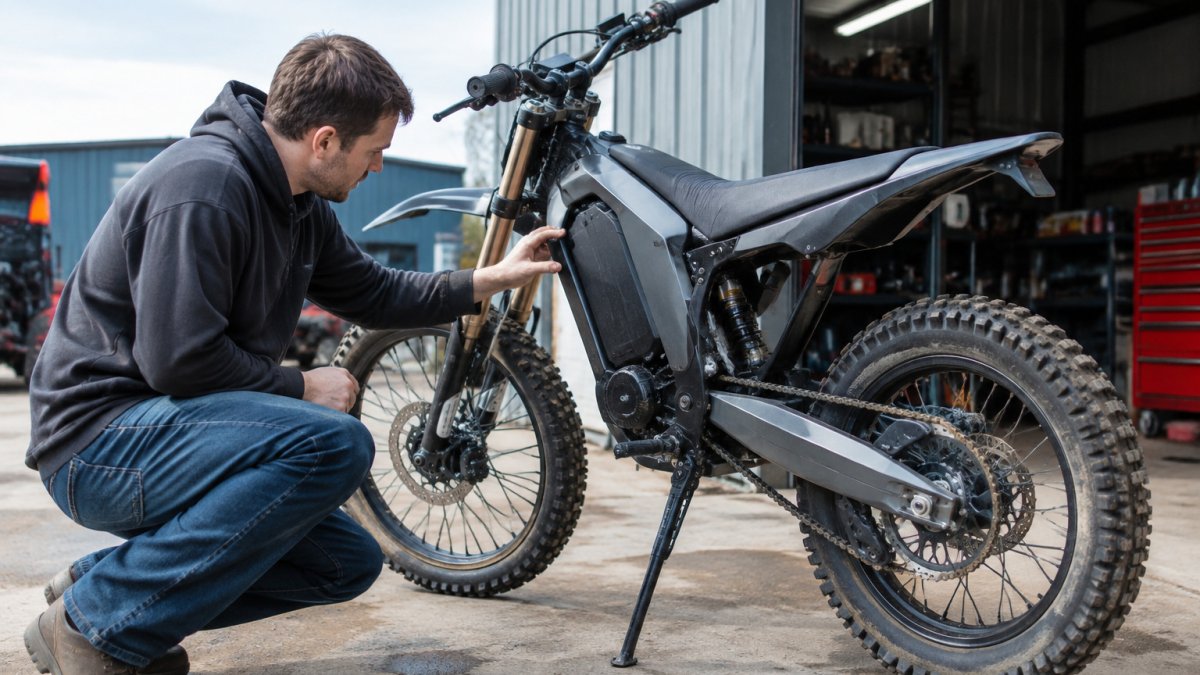
Learning how to inspect a used electric dirt bike starts at the chassis, not the battery. The frame carries every load the motor and suspension throw at it, and hidden cracks are the hardest fault to fix. Structure problems often kill a deal faster than a weak battery, so checking the chassis first is a sound order of work.
Frame Cracks, Bends, and Alignment
Wipe the frame down and put a flashlight on every weld. Look closely at the head tube, the shock mount, and the swingarm pivot.
- Cracks or spider lines in the paint near welds
- Dents or bends in the downtube
- Uneven gaps where the subframe meets the main frame
A cracked frame is a walk-away sign on most e-moto models. Repairs rarely hold up to hard riding.
Pivot Bearings, Fork Seals, and Rear Shock
Lift the rear wheel and rock the swingarm side to side. Any clunk means worn pivot bearings.
Check the fork tubes for oil rings and pitting. Push down on the rear shock and watch for smooth return.
Worn tires, bent rims, and loose spokes also show up here. If the wheels need replacing, you can shop dirt bike tires before you commit to the bike.
How to Check Used Electric Dirt Bike Battery Health
Battery health decides what a used electric dirt bike is really worth, and it is the check most sellers hope you skip. A pack that holds a full charge and shows steady voltage under load is the goal; swelling, corrosion, or a charger that cuts out early are red flags. Here is a practical, safe process, and an honest account of what a driveway inspection can and cannot prove.
Step 1: Visual and physical pass (before you touch a meter)
- Any bulge or swelling in the battery pack, a swollen pack is a walk-away sign, not a negotiation point
- Corrosion, rust, or green crust on the terminals and connector pins
- Water intrusion signs around the casing: staining, cracked seals, fogged display
Watch out: never open a battery case, probe inside the pack, or attempt a cell-level test yourself. High-voltage DC packs can deliver a fatal shock even when the bike is off, and opening the case voids any remaining warranty.
Step 2: Charge-behavior check
Ask the seller to charge the bike fully before you arrive, then watch the charger and display during the last part of the cycle. A healthy pack reaches full charge and the charger shuts off or drops to a maintenance state. A charger that runs hot, never terminates, or a display that reads full then drops several bars within minutes points to weak cells.
Step 3: Voltage check with a multimeter (where appropriate)
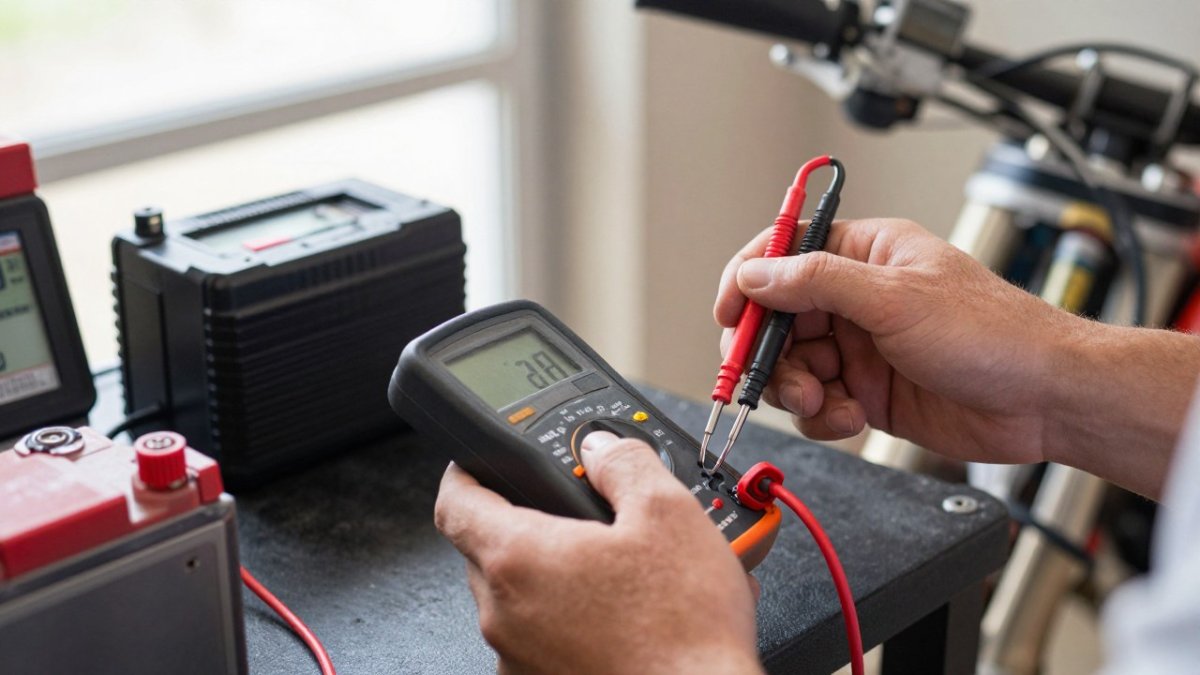
Only probe the pack's external charge or discharge terminals if they are exposed and labeled, never disassemble anything. Set the meter to DC volts, confirm the range exceeds the pack's rated voltage, and compare the reading to the pack label. A fully charged pack should read close to its rated voltage; a pack that reads well below rated voltage after a full charge is suspect.
Step 4: Load and range evidence
Voltage at rest tells you little. Watch the display during a short ride: a charge level that sags fast under acceleration and recovers slowly when you coast means the cells are tired. Compare the seller's range claims to the pack's rated capacity and the bike's typical consumption, a claim far above what the pack size supports is a red flag.
What a basic inspection cannot prove
A visual check and a multimeter reading cannot measure remaining capacity, internal resistance, or cell balance. Those require a load test or a battery-management-system readout, usually from a dealer or technician with the right tool.
If the pack fails inspection, browse replacement batteries or a Light Bee X battery to price the fix before you negotiate.
Motor, Wiring, and Electrical Controls
Electrical faults can be costly, so test the controls carefully. Power up the bike and test every control before you touch the throttle.
- Twist the throttle slowly and listen for smooth response
- Check the display for error codes
- Test every switch, light, and kill switch
Open the controller cover and look for corrosion, water intrusion, and loose connectors. Green crust means moisture got in. Pull gently on each plug; a loose connector can cut power mid-ride.
A common mistake is skipping the controller. If you find wiring damage or a fault code tied to the controller, an EBMX X 9000 V3 controller kit is one route to a fix, but confirm the diagnosis first.
How to Test Ride a Used Electric Dirt Bike
A structured test ride is the only way to confirm how a used electric dirt bike behaves under load, and most listings never get one. Plan fifteen to twenty minutes and run the same sequence every time so you can compare bikes fairly. Ride only on private property with the owner's permission or in a legal riding area, and confirm the local rules with the state and local authorities first.
Before you ride: cold-start check
Power the bike on from cold and let it sit for a minute. Listen for fan noise, relay clicks, and any whine from the controller. Note the display's state of charge and any error codes before you move. A bike that throws a code at idle has a fault you will feel under load.
The ride protocol
- Slow figure-eights in a flat area: check steering head bearings, brake feel, and low-speed throttle smoothness. A notchy or loose steering head shows up here.
- Hard acceleration once from a stop: the motor should pull smoothly with no hesitation, grinding, or surging. Note whether the charge bars sag sharply and recover.
- Firm braking from moderate speed: the lever should feel firm, not spongy, and the bike should stop straight without pulling. Listen for rotor scrape or pad squeal.
- Bumps and curb drops: listen for suspension clatter, bottoming, or a clunk from the pivots. A rear shock that packs down or rebounds harshly is tired.
- Coast and listen: cut the throttle, grinding from the motor, clicking from the chain, or rattles from the frame are easier to hear without motor noise.
- Repeat the acceleration and braking once more to confirm the first pass wasn't a fluke, and watch for codes that appear only under load.
Reading the symptoms
- Grinding or whine from the motor under load: bearing or gear wear, potentially expensive
- Clicking that tracks wheel speed: chain, sprocket, or freewheel wear
- Clunk over bumps: pivot bearings or shock mounts
Match the wear to the story
Hard riding leaves marks: scuffed cases, bent levers, worn sprocket teeth, and scratched fork lowers. Ask how the bike was used, track, trail, or street, then check whether the wear matches the story.
Watch out: if the seller refuses a test ride, limits you to a few seconds in a parking lot, or insists on holding the title until after the ride, treat that as a red flag and walk away.
Used Electric Dirt Bike Maintenance Records and Paperwork
Paperwork protects you as much as the inspection does. Ask for the serial number, proof of ownership, and any service history before money changes hands.
- Title or bill of sale matching the serial number
- Maintenance records showing battery and brake service
- The original charger and any spare keys
No records is not automatic disqualification, but it lowers the price you should pay. Verify the serial number against the frame stamp. If a seller dodges questions about ownership, walk away. Fraud is common in private e-moto sales, and a clean paper trail is your best defense.
Your Used Electric Dirt Bike Inspection Checklist
Use this pass/fail checklist during every inspection. Print it, bring a flashlight and multimeter, and score each line before you decide.
| Check | Pass Looks Like | Fail Sign |
|---|---|---|
| Frame | Straight, clean welds | Cracks, bends, dents |
| Pivots | No play when rocked | Clunk, ovalized holes |
| Suspension | Smooth, no leaks | Oil rings, blown seals |
| Battery | Holds charge, steady voltage | Swelling, fast drain |
| Wiring | Clean, tight connectors | Corrosion, water damage |
| Motor | Smooth pull, quiet | Grinding, hesitation |
| Brakes | Firm lever, thick pads | Spongy lever, worn rotors |
| Tires and wheels | Even tread, true rims | Cracks, bent rims, loose spokes |
| Test ride | No noises, no codes | Rattles, error codes |
| Paperwork | Serial matches, records | No title, dodged questions |
Score it honestly. Two or more fails in the frame, battery, or motor rows means repair costs likely outweigh the discount.
If you are shopping near Le Roy, our team can help you compare models and answer questions before you buy. When you are ready to see what is on the floor, find a dirt bike dealership near you.
Frequently Asked Questions
What should I check when buying a used electric dirt bike?
Work through the bike in order: frame, suspension, and wheels first, then battery health, motor and wiring, brakes and controls, and finally a real test ride. Ask for maintenance records and proof of ownership before any money changes hands. A used electric dirt bike that passes all of these checks is far less likely to hide expensive problems. If you are unsure, have a dealer inspect it before you commit.
How can I tell if a used electric dirt bike battery is still good?
Start with a visual check for swelling, cracks, or corrosion at the terminals. Then charge it to full and watch the voltage with a multimeter, and note how quickly the charge level drops during a test ride. Ask how the seller stored the pack and how often it sat at full or empty. A battery that swells, heats up, or loses range fast needs replacement, which is a major cost. For used electric dirt bike battery health, a dealer load test gives a clearer answer than a parking-lot check.
How do you test ride a used electric dirt bike before buying it?
Ride for at least 10 to 15 minutes on varied ground, not just a flat driveway. Accelerate hard, brake hard, and listen for unusual noises from the motor, chain, and wheel bearings. Cycle through every throttle and power mode, watch the display for error codes, and check the charge level before and after. Feel for play in the steering and suspension. If the seller will not allow a proper test ride, walk away.
What documents should I ask for when buying a used electric dirt bike?
Ask for proof of ownership, the serial number matching the frame, and any maintenance records or service history. Receipts for battery or controller replacements are especially useful. Confirm how the bike is titled or registered and whether it is legal to ride where you plan to use it. A seller who cannot produce paperwork or whose serial number does not match is a red flag, and no inspection checklist can fix that.
Buying used saves money only when you know what you are looking at. At 7S PowerSports, LLC, we run a New York State authorized motorcycle inspection station, stock OEM and aftermarket parts, and service Surron and E-Ride Pro electric dirt bikes in our Le Roy shop. Bring us a bike you are considering and we will help you spot the problems before they cost you. Get started with 7S PowerSports, LLC and ride away knowing your used electric dirt bike is sound.